
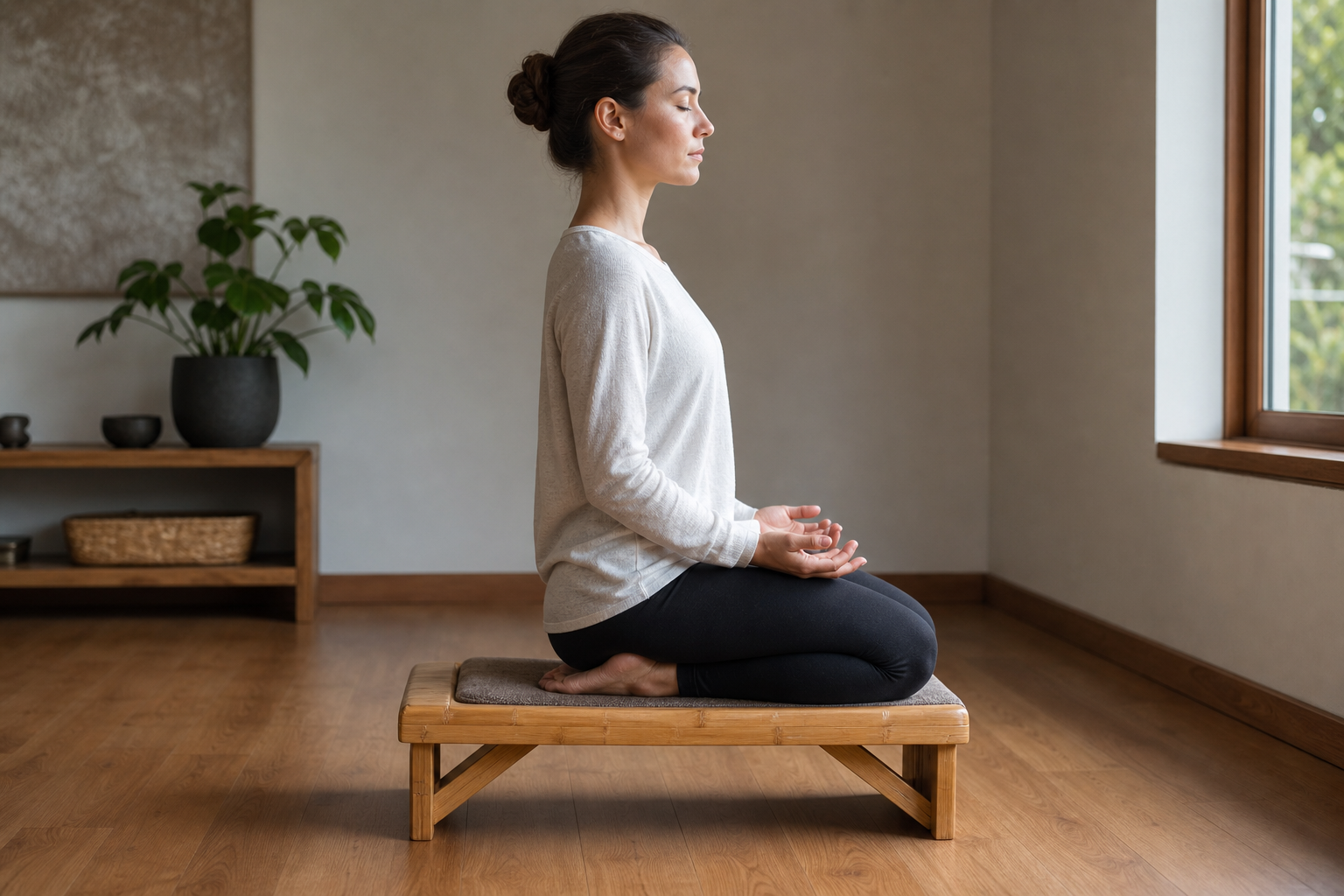
A meditation bench, also known as a seiza bench, is designed for meditation in a kneeling posture. You don't sit cross-legged, but on your knees, with your feet resting under the bench. This reduces direct pressure on the ankles and makes it easier to maintain a stable, upright sitting posture.
For many people, this is the biggest advantage: less physical distraction during meditation. Those who suffer from stiff hips, numb legs, or lower back tension often find that a meditation bench provides more support than sitting directly on the floor. Within the BUDDLEY assortment, you will find both a general collection of meditation benches and a bamboo meditation bench with a foldable design.
Why your back will thank you

A good meditation bench usually has a slightly slanted seat. This angle subtly helps to tilt the pelvis forward, which better maintains the natural curve of the lower back. This allows the spine to remain straight more easily without you having to constantly actively correct it.
This is important during meditation, because a stable and neutral posture requires less muscle effort. If you are less concerned with slumping or holding tension in your back and shoulders, more attention remains for breathing and concentration.
[IMAGE: Someone sitting in a perfectly upright posture on a meditation bench]
More comfort for knees and ankles
A meditation bench is used in the Japanese seiza posture: you kneel on the ground, but your body weight largely rests on the bench. Your feet lie under the bench, so your ankles don't have to bear the full weight. For many people, this immediately feels less stressful than sitting folded up for a long time without support.
The knees are also often experienced as less heavily loaded than when sitting cross-legged for a long time, especially if the hips are less flexible. Instead of turning the legs wide open, you keep the body in a more rectilinear and structured posture. The BUDDLEY bamboo meditation bench is specifically described as a model that supports an upright sitting posture and reduces pressure on the knees and lower back.
Meditate longer with less physical distraction
Many people don't want to stop meditating due to restlessness in the body, but due to pain points such as numb feet, pulling knees, or a tired lower back. A meditation bench doesn't always completely eliminate these problems, but it can significantly reduce them. This makes it easier to sit still for longer periods.
Less physical distraction often also means deeper concentration. Your attention needs to shift less often to posture, pressure points, or tingling sensations. Especially during sessions of 15 minutes or longer, this can make a noticeable difference in peace and focus.
Bench vs. cushion

The choice between a meditation bench and a meditation cushion mainly depends on your body and your preferred position. A bench is usually more logical if you like to kneel, have difficulty with hip mobility, or want less pressure on your lower legs and ankles. A cushion is often a better fit if you can comfortably sit cross-legged or in another crossed sitting posture.
A bench generally provides a more fixed and structured sitting posture. A cushion, on the other hand, offers more freedom to adjust your legs and sitting angle. Anyone who notices that sitting cross-legged quickly causes tension often benefits more from a bench than from a zafu.
| Feature | Meditation Bench | Meditation Cushion |
|---|---|---|
| Sitting posture | Kneeling in seiza posture | Mostly cross-legged |
| Support | Fixed and structured | More flexible |
| Suitable for stiff hips | Often yes | Not always |
| Pressure on ankles | Usually lower | Depends on posture |
[IMAGE: Comparison between someone on a meditation bench and someone on a meditation cushion in the same room]
The advantage of a foldable model
For home use, stability is important, but portability can be just as relevant. A foldable meditation bench is easier to take to a retreat, yoga class, or quiet space while traveling. It is also practical at home if you want to store the bench compactly after use.
The foldable bamboo meditation bench from BUDDLEY was developed precisely with that in mind: it combines support for an upright sitting posture with a foldable design for meditation, yoga, or prayer. This makes a foldable model especially useful for people who regularly meditate in different places.
How to correctly sit on a meditation bench
- Place a mat or soft surface to support your knees.
- Kneel in a seiza posture.
- Place the bench over your lower legs, so your feet rest under the bench.
- Let your weight sink onto the seat instead of your ankles.
- Tilt your pelvis slightly forward and lengthen your back, but don't stiffen it.
- Relax your shoulders, jaw, and hands.
If you notice that your lower back is arching or your upper body is stiffening, you are probably too tense. The correct posture feels straight and alert, but not hard or forced.
Frequently Asked Questions
What exactly is a meditation bench?
A meditation bench is a low bench for meditation in a kneeling seiza posture. You sit on the bench while your lower legs and feet rest underneath it.
Is a meditation bench better for your back?
For many people, yes, because the slanted seat helps to tilt the pelvis forward and keep the spine more naturally straight. This can reduce the strain on the lower back and shoulders.
Who is a meditation bench suitable for?
For people who have difficulty sitting cross-legged for long periods, have limited hip mobility, or want less pressure on their knees and ankles during meditation.
What is the advantage of a foldable meditation bench?
A foldable model is easier to carry and compact to store. This is convenient for home, travel, and retreats.