
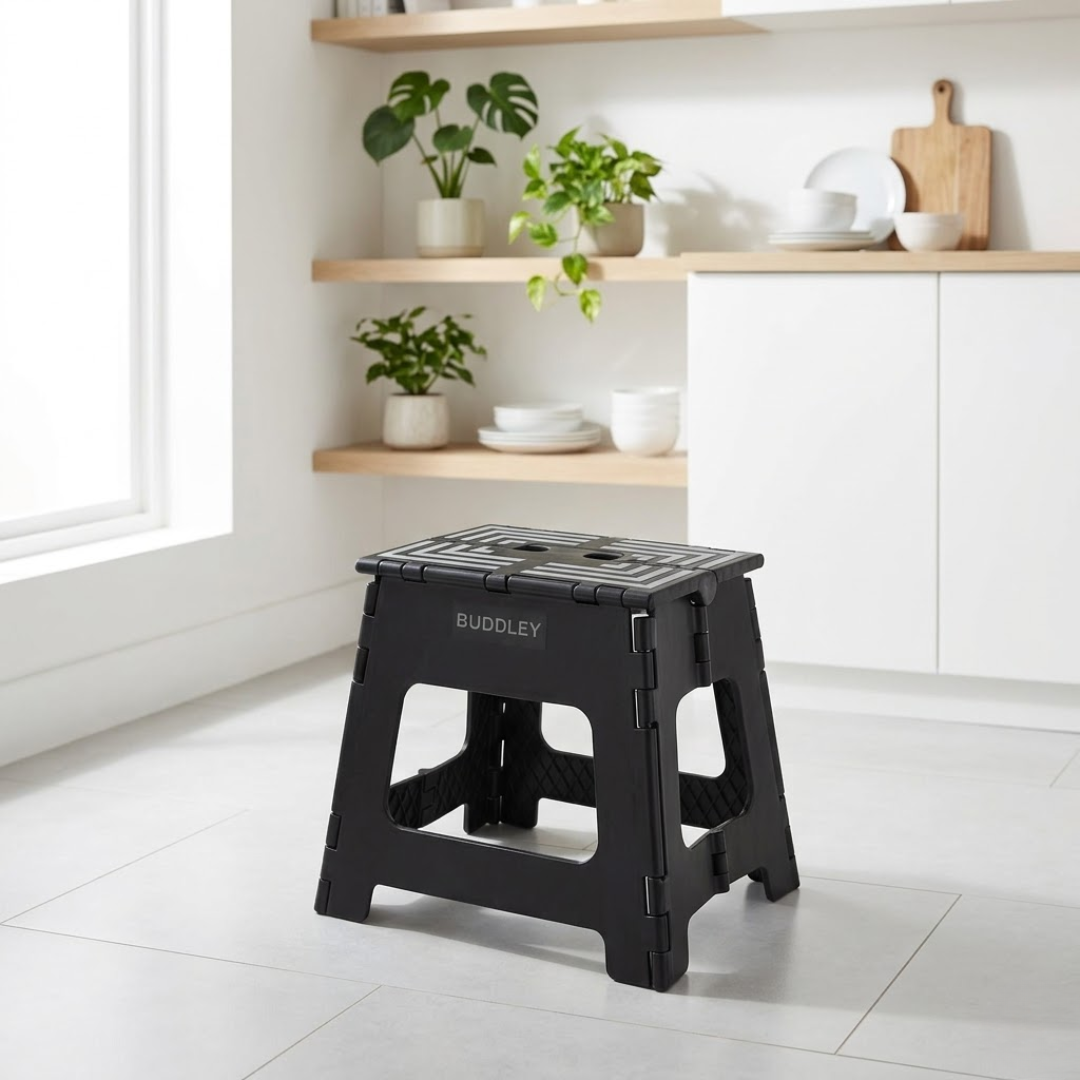
A black step stool is usually sought as a compact aid to reach higher in the kitchen, bathroom, hallway or storage room. The main choice is not about the color, but about safety and ease of use: height, stability, anti-slip, and load capacity determine whether the step stool fits the situation. Below you will find a step-by-step plan and checkpoints to assess a black step stool without assumptions about brand or model.
When is a black step stool the right solution?
A step stool is intended for short, low steps: for example, for high kitchen cabinets, a top shelf in the closet, or to help children reach a sink. For tasks requiring lateral reach, greater height, or longer duration, a household ladder or stepladder is often more stable. Choose a step stool primarily when you quickly need a few extra decimeters of height and use it on a flat surface.
Height and working height: how to avoid unnecessary risk
The product height (e.g., 20 to 30 cm) is not the same as the working height: working height is roughly your standing height plus arm's length. The higher you stand, the greater the risk of losing balance, especially without a railing. Therefore, prefer the lowest height that still allows you to safely reach your goal, and avoid reaching on your tiptoes.
Anti-slip and stability: the most important safety check
Check if the stepping surface has an anti-slip texture or anti-slip layer and if the legs are equipped with rubber caps or feet. Stability also depends on the footprint: a wider base generally provides more security on slippery floors. Only use a step stool on a flat, hard surface; on carpets or uneven tiles, it may wobble more easily.
Quick check before use
- Does the step stool stand flat on the ground with all legs without tilting?
- Are the anti-slip feet intact and clean (no dust or grease)?
- Is the stepping surface dry and free of loose materials?
Material choice: plastic, metal or wood
Plastic step stools are often light and easy to move; pay extra attention to the stiffness and anti-slip properties of the surface. Metal step stools can feel stiffer and often have a textured stepping surface; check for sharp edges and ensure the metal is not slippery when wet. Wooden step stools can be solid and often fit into the interior, but require attention to finish (no splinters) and anti-slip under the legs.
Foldable or fixed: what suits storage and daily use?
A foldable step stool is useful if you have limited storage space, but check the hinge and locking mechanism: it must lock firmly and intuitively in the open position. A fixed step stool has no moving parts and may therefore be easier to check for play. In both cases: if you notice play, cracks, or a creaking frame, do not use it.
Load capacity and standards: what you can and cannot infer
Adhere to the manufacturer's stated maximum load capacity and account for a safety margin for dynamic loads (e.g., stepping on and off with a full bag). A general guideline is not to use a step stool as a stool to jump on or as a temporary ladder replacement. If the product mentions a standard reference or quality mark, check the product specifications to understand exactly what that means; do not infer additional properties without documentation.
Use in kitchen and bathroom: moisture, cleaning and floor contact
In the bathroom, moisture and slippery floors play a larger role; in that case, only choose a step stool with good anti-slip feet and a non-slip stepping surface, and dry it after use. In the kitchen, contamination from grease or crumbs is a concern: clean the stepping surface to keep it non-slip. Do not place the step stool in wet areas and avoid use with wet socks if the surface is sensitive to it.
Safe stepping: simple rules that prevent many incidents
Always place the step stool directly in front of you and do not climb on it from the side. Keep your center of gravity above the stepping surface and move the step stool instead of reaching too far. Preferably wear shoes or slippers with grip and do not use a step stool if you are dizzy or have used alcohol/medication that can affect your balance.
FAQ
How high is an average step stool?
Many step stools for home use are roughly in the range of about 20 to 30 cm high, but this varies per model. Always check the stated product height in the specifications.
Is a black step stool inherently anti-slip?
No. The color says nothing about grip; anti-slip depends on the material and finish of the stepping surface and the feet. Look for an anti-slip texture, anti-slip layer, and rubber feet.
Can I use a step stool as a stool to sit on?
Some models are suitable for this, but this depends on the design and load capacity. Only use it if the manufacturer specifies it as a stool or seat and if it remains stable under lateral load.
What is safer: a foldable or a fixed step stool?
Both can be safe if they are well-designed and undamaged. For foldable models, the locking mechanism is an extra checkpoint; for fixed models, you primarily pay attention to stiffness, anti-slip, and flat standing.